GameStop is More Than Just a Meme Stock. It’s an Uprising Against Financial Corruption.
The first time someone mentioned GameStop’s stock to me, I didn’t even listen long enough to hear about what was going on. To me, the kind of person who enjoys living under a rock, this seemed like more passing pointless news. But it was mentioned to me again and again, so I decided to look into the matter. And what I found was amazing.
The most common understanding of GameStop’s performance seems to be something along the lines of “a bunch of Redditors realized stocks like GME and AMC were over-shorted and are orchestrating a short squeeze to get rich.”
If you have never read about anything pertaining to the stock market before, here is a vocabulary guide:
Over-shorted: When a stock has more short positions against it than long. For instance, there are 100 shares of a stock, 100 long positions open, and 120 short positions open.
Long position: Owning a share of a stock. Buy low, sell high.
Short position: Selling a share of a stock you don't own, agreeing to buy it back later. The reverse of buying an ordinary share. It's "buy low, sell high," but in reverse -- sell high, then buy back low later. Used for stocks which are on an invetiable downslide.
Short squeeze: When you have a short position, you are legally obligated to buy back at some point because you have sold that which you do not own. You must buy back from long position holders when they sell, regardless of the price. If you opened a short position (sold stock you don't own) and the price of the stock went up, you must close your short position (buy) and lose money.
When there are more short positions than long open, that means there are literally not enough stocks in existence for the short sellers to close all their positions.
Occasionally, investors with long positions notice this, and they refuse to close their positions (sell) to the people with short positions (who buy back) in an effort to raise prices. The people trying to close short positions generate infinite demand, causing infinite price increase on the long positions, driving stock prices up - in theory - infinitely. This happened to Volkswagen in 2008.
In plain English, “a bunch of people online realized a fabulous opportunity to make a bunch of money on the stock market.”
While there are a bunch of people getting rich here, “get rich” isn’t most people’s motivation for buying GameStop. If you look at the subreddit the movement started on, /r/Wallstreetbets, it looks like getting rich is at the bottom of many people’s priority list.
Their first priority? Fucking the bankers who fucked them over in 2008.
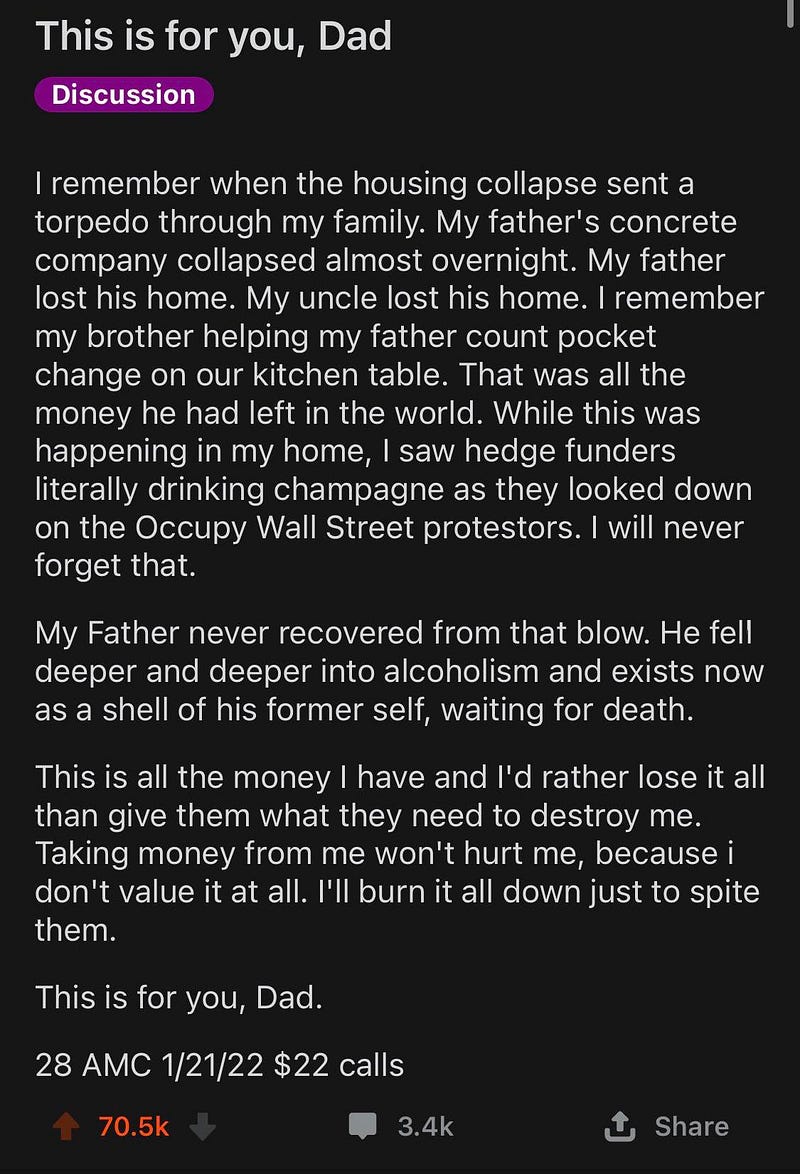
/r/Wallstreetbets is swamped with stories like these. Stories of people who lost their homes and had to live in basements, living off of powdered milk and pancake mix for years, watching loved ones succumb to alcoholism and drug abuse from the sheer misery — and stories of the Wall Street bankers who were bailed out and kept their cushy mansions while the people whose pensions they lost suffered and died in poverty.
From what I understand, the 2008 housing crisis was basically the opposite of the GameStop crisis. Rich billionaires manipulated the market and got even richer at the expense of ordinary people who did not have a lot to lose in the first place.
Buying GME is these ordinary people’s opportunity to turn the tables. This time, it’s ultra-wealthy hedge fund managers and billionaires who are going to lose their shirts, not ordinary people. Neighborhood millionaires are being made left right and center on GME stock, and that money is coming right out of the pockets of billionaires.
That’s why GME’s price hasn’t gone down even though Robinhood and other major brokers have repeatedly halted trading and attack ads are being taken out against ordinary investors: for them, it’s personal. They’re willing to lose every dime they’ve invested if it means the hedge funds will too.
And the billionaires are running scared. Robinhood and other major brokers have intermittently halted trades on GameStop stock, attempting to control prices so they don’t lose too much money when they close their short positions. Every hedge fund manager and high-profile investor available has done rounds on the major news networks, trying to convince ordinary people this will end badly for them and that they should get out of the market while they can. It’s hard not to see this as a blatant attempt to mislead people because so far, ordinary people aren’t the ones who are losing.
Said billionaires have accused the ordinary people of buying GME of all kinds of things, but mostly their accusations have centered around claims that “Reddit is manipulating the market” and that they are “attacking the rich.”
To claims that Reddit is manipulating the market:
- Market manipulation requires a coordinated effort of some kind. Anyone who’s ever used Reddit for more than ten minutes at a time knows that the mob mentality that arises from Reddit often appears coordinated, but is the equivalent of a hurricane. This is not the result of some small, crafty group of market manipulators, which is the kind of scenario those laws were invented to protect against.
- The financial crisis of 2008 was, from what I understand, the direct result of market manipulation by bankers, hedge fund managers, billionaires, and other major financial actors. That time, a much smaller group of people manipulated the market on a much larger scale. And what punishment did they receive? A slap on the wrist.
To claims that these people are attacking the rich…
…the claim “attacking the rich” sounds laughable.
What’s the attack? That retail investors are taking “your” millions from you, forcing you to… live off of the same amount of money everyone else does? That’s not an attack, hon. That’s life. Or at least, that’s been life for everyone under the boot of the financial elite for the last few decades.
According to hedge fund billionaire Leon Cooperman, linked above under “attacking the rich,” he says…
“This whole concept of “fair share” (used to justify the stimulus checks) is a bullshit concept… it’s just an opportunity to attack the rich.”
Cooperman, do you realize you sound like a cartoon villain? Millions of ordinary people in this country have been struggling to make ends meet for years now. No, I don’t mean struggling to cover their short positions, I mean struggling to put food in their mouths. While you’ve sat in business meetings at long oak tables and negotiated financial plans that leave you with at least a few million, millions of people have trudged to 10-hour workdays at McDonalds to make less than $75.
All that’s happening here is that, thanks to the internet, retail investors are now educated enough to use your own tricks against you. Doesn’t feel so good to be on the losing side, does it?
My tone in this article may seem unsympathetic. That’s because I am unsympathetic. I live on an annual income of around $24,000, and while I sometimes wish I made a cool $30,000 a year, I have had about enough money to do everything I want to do. It disgusts me that these millionaires and billionaires have anything less than sheer and complete gratitude for their fortunes.
I’m generally OK with millionaires and billionaires existing. I aspire to be a millionaire someday. My problem is not with wealth itself, but with people who feel entitled to their wealth, people who are so out of touch with what it’s like to not be wealthy that they start saying things like “fair share is a bullshit concept.”
In the same interview he called fair share a bullshit concept, Cooperman said he thinks retail investors shouldn’t be allowed to use fee-free platforms like Robinhood to trade stock using their stimulus checks because it’s a “loser’s game.”
But who’s losing right now, Cooperman? Because it isn’t the retail investors.
In summary, this “fiasco” with GameStop stock isn’t just some financial fiasco. This is a lot more than a bunch of people looking for a get-rich-quick scheme. The rise of GameStop stock is the rise of retail investors who are tired of being financially dicked over by billionaires who routinely flout the rules and suffer no consequences.
Even experienced Wall Street guys have no idea how this is going to play out in the long run, so I’m not even going to try and guess. It could create neighborhood millionaires long-term and correct our completely inaccurate stock market system, or it could crater our economy, depending on what the so-called regulators decide to do.
Honestly, I don’t care too much. Because the people on /r/Wallstreetbets are right — we have nothing to lose.¹ We’re already poor! The worst that could happen is that we stay poor.
The best that could happen is that the government finally steps in with appropriate regulation, billionaires are no longer allowed to use their massive power to flout rules at the expense of the masses, and regular people have a shot at building wealth again for the first time in decades.
Want More Great Articles?
If you want to read more thought-provoking articles like this one, my weekly digest is just the thing for you.
Click to join my Weekly Digest today!
1: By “we,” I mean people who are not millionaires or billionaires. As of this writing, I have no financial position in GameStop.
Enjoy this kind of writing?
I send one email a week about AI, intentional living, and doing meaningful work in a world that won't stop changing. Join 700 other subscribers.
Keep Reading
Your Clothes Use More Water Than Your AI
The environmental case against AI doesn't survive contact with the data
Apps Will Soon be Replaced by AI
The first new computing interface in sixty years doesn't need them.
AI Is Building the Biggest Porn Machine in History
The industry that monetizes child rape videos just got mechanized production