How To Get a Content Creator To Feature Your Startup

As an online writer, I receive a lot of pitches from entrepreneurs who are looking for free press for their new product. They often arrive in the form of a cold email or cold LinkedIn message from someone I’ve never met, often to “let me know” about a new product or service they are launching.
I’m not special in this regard. Any content creator with an audience of a few thousand people or more gets these pitches. They range from generous offers to beta-test software to purely self-interested requests for us to feature their product or service in our writing.
I hate 99% of them.
These pitches are terrible. It’s clear the writers know nothing about me other than the size of my audience. They must think the world revolves around them if they think they can get me to offer my entire 17,000-person audience to them just because they sent me a cold email.
Sending me a terrible self-interested pitch is a good way to guarantee that not only will I not feature your product, but that I never will.
Not all pitches are bad, though. It’s possible to write a pitch email, even a cold one, that will get a warm and welcoming response from me. I want people to pitch me, after all — good pitches help me make connections and fertilize my writing. My only problem is so few people know how to write a good pitch.
This is an article about how to write a pitch that a content creator like me would be happy to see in their inbox.
First, Make a Good Product
The most common reason I reject or ignore pitches is that the product that’s being pitched just isn’t good.
As a content creator, I only want to highlight products that I’m convinced will really make the life of my readers better. There is an entire world of advertisements already trying their hardest to make my readers part with their hard-earned money, and I don’t want to add to the problem. So when I do recommend something to my readers, I do so with great care.
The vast majority of pitches I receive in my inbox, however, are to feature products that just aren’t good. They’re usually ugly looking, clearly still in alpha or beta, and have an unappealing marketing message that betrays both a fundamental misalignment with the market and a lack of attention paid to copywriting.
Products I feature to my readers are best-in-class, high-quality, and stable. They have a clear value offering that I can summarize in one or two sentences, an offering that I feel will be instantly appealing to my readers. Most importantly, they are life-changing; these products are among the few I rely on day in and day out.
If your product isn’t that good, it doesn’t matter how good your pitch is. You won’t get featured. I may send you a reply saying “Thanks for contacting me,” but that’s all I’ll do.
Don’t Pretend To Care About Their Content
I’m not a big believer in the advice that you have to “get familiar with their content” before reaching out. I receive plenty of pitches from people who don’t read my work, and it doesn’t bother me at all. I know from experience that people who are founding businesses and doing marketing work don’t usually have the time to spend three hours reading my blog articles for the sake of one pitch.
So if you want to pitch me without having read much of my content, that’s fine!
What’s not fine is what so many people do — pretend to have read my articles when they clearly have not.
A solid 50% of the pitches I receive have an email subject like this: “My top 5 favorite productivity apps.” I get excited when I see them, thinking I’m getting feedback on an article from one of my readers, and then I get this:
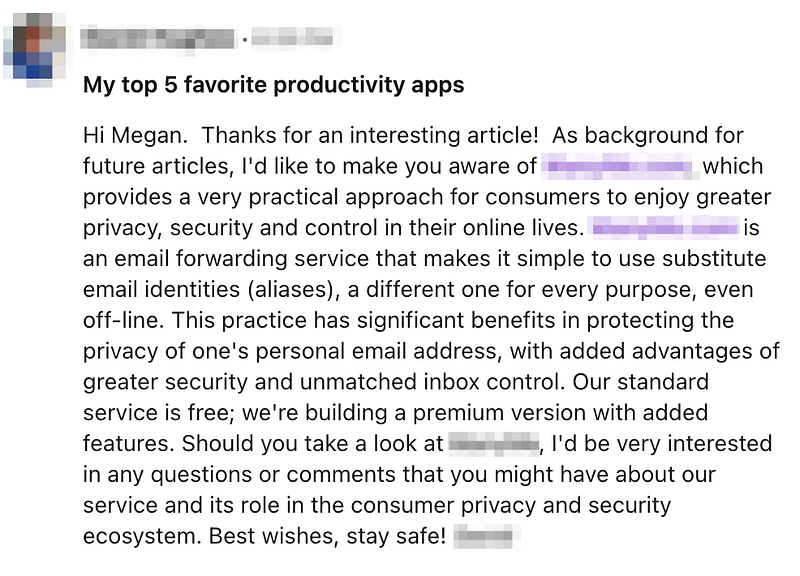
What a huge disappointment. I opened the article expecting reader feedback, and it’s a self-interested pitch.
Pro tip: if the first thing a content creator feels upon reading your pitch is disappointment, your product is not going to get featured.
In a paragraph of text, he literally spent less than one line on my writing — and that one line was such a generic compliment it could be applied to any article writer anywhere, leading me to think he’s copy-pasting this pitch email into the LinkedIn message box of any content creator he can find.
The subject line was designed to make me think this email is from a real reader who wanted to discuss my work, but the actual email is just self-promotion. This message was a trick, and I don’t want to do business with people who trick me.
Sending me a pitch if you haven’t read my work is no big deal. I know marketers are not going to spend much or any time reading my content before sending me a pitch. But pretending to have read and cared about my work when you haven’t makes me dislike you. This person would have had a better chance of attracting my attention if they sent me an email with the subject line “Would your readers be interested in email forwarding?” and had been honest about the fact that they don’t read my content.
If you want your pitch to be successful, actually consume their work
I’m not openly offended by cold pitches from people who aren’t my readers, but I’m not likely to pay them much mind, either. The pitches that get my attention are those by people who have made it clear they are regular readers of my work.
I love my readers. Every email from a reader is my favorite email of the day. Readers email me to tell me about ways my work helped them improve their career or skills, even sometimes going so far as to say I’ve changed their life. (Their words, not mine). Readers also email me to comment on my work, correct me where I’m mistaken, and let me know about cool stuff I might not know about. After a few exchanges like that, I’m willing to do a lot for a reader.
It’s easy to take advantage of this effect in a pitch. Just read everything they’ve consumed in the last month or two. Make sure you understand what they produce content about and what direction they’re taking their content. When you make your pitch, reference two or three pieces of their work, and spend 1/3 or more of your pitch just discussing what you think about them.
Use that discussion to segue into talking about your product. Show the content creator how their content and your product support each other. The foundation of a successful pitch is getting a content creator to see how your product can become a part of their content and make their content better.
You can only pull off that sort of pitch if you’ve actually spent some time consuming their content, so make sure you do.
Make Your Email Pitch About Them
The second sin of the pitch message featured above is that it was almost entirely about this person’s product. They told me what their product is, what it does, and why those kinds of products matter. But what they didn’t tell me is why I or my readers should care.
This mistake is particularly egregious when it would have been so easy to do. Part of their pitch was about how email forwarding services can be important for consumer privacy and safety. I’ve written multiple articles about the importance of internet privacy and have an entire subsection of my content dedicated to being critical of modern privacy-invading technologies.
- But did they discuss their thoughts on any of those articles? No.
- Did they suggest some articles of mine where email forwarding could have been mentioned as important? No.
- Did they even mention that I write primarily about productivity and relate email forwarding to productivity? No.
Essentially, what is wrong with the body of this pitch is that he gives me the facts about email forwarding and leaves it entirely up to me to figure out why I or my readers care about email forwarding.
Make it clear to the content creator why they and their followers should care about what your product does.
Suggest some content ideas to them (but be careful)
To make it extra-easy for the content creator, you could suggest headlines or outlines for their content. I know I would certainly be interested if someone’s pitch included thought-provoking and valuable headlines for me to write about.
But of course, to do this, you will need to be able to write good headlines, and you will need to write headlines that appeal to a content creator trying to appeal to readers.
The following headline suggestions would have been BAD:
- The Best Email Forwarding Service Ever
- Why You Need [Name of Service] for Your Email Forwarding
- The 5 Best Email Forwarding Services
These are just advertisements disguised as headlines. Some specialty blogs might appreciate the last headline, 5 best email forwarding services, but I’m not a specialty blogger focusing on email forwarding services and internet privacy. I’m a general content blogger, and my readers don’t care at all about the 5 best email forwarding services. Someone familiar with my content would know that.
GOOD headlines would have been:
- How You Can Use Email Forwarding to Protect Your Privacy and Why You Should
- 5 Clever Ways You Can Protect Your Privacy on the Internet
- Why Personal Internet Privacy is More Important Than Ever
These are things I care about. These are things my readers care about. These are good headlines.
Explain Why You’re the Best
Finally, after doing every other part of this process, explain why your product is the best solution to their problem.
Essentially, all the work you’ve done earlier with discussing their content and finding a niche for your content to fit in is the act of explaining a problem to the content creator. You’ve shown the content creator a hole in their work, a place where their portfolio could be enhanced by featuring a product like yours. But who’s to say your product is the best?
Consider the email forwarding pitch. They briefly mentioned the name of their email forwarding service, but they spent the bulk of the email explaining what email forwarding is and how it can help people. They didn’t discuss the relative merits of their email forwarding service compared to their competition.
Because they never explained why their email forwarding service was best, my first thought after reading this pitch was “I know there are already a zillion email forwarding companies. Is this a well-known one?” I Googled “email forwarding service” and wouldn’t you know, this person’s company was not in the “best email forwarding service” article I found as a result.
Once you’ve done all the work and the content creator understands why a product like yours will enhance their portfolio, make sure they understand why your product is the best product (or even the only) product to do so.
Offer Them Something
A base reality about human psychology is that we like free stuff. I’m no exception; when someone sends me a pitch that includes a special offer for an extended free trial of their software, I nearly always reply quickly. I am a productivity writer because I like productivity stuff, so productivity software manufacturers giving me free trials of productivity software is a dream come true.
And, of course, they get what they came for too. If I try their software and genuinely think it will make the lives of my readers better, I write about it and let them know.
When people pitch me to “let me know” about their software, however, I’m usually not interested. I don’t have the disposable income to be dropping money on subscriptions for every piece of software someone emailed me to “let me know” about.
If you want a content creator to spend time with your product and recommend it to their audience, make it free for them. Don’t expect them to pay for your product and endorse it.
Now, if you have made all these mistakes, often and with vigor, don’t get down on yourself. I have, too. Before becoming a content creator, I was a product entrepreneur, and I’ve sent thousands of these self-absorbed and self-interested pitches only to lay awake at night wondering why no one would email me back. What finally taught me how to write a good pitch was being on the other side.
Keep these guidelines in mind when pitching content creators, and you’ll start seeing a lot more success with your pitches.
Enjoy this kind of writing?
I send one email a week about AI, intentional living, and doing meaningful work in a world that won't stop changing. Join 700 other subscribers.
Keep Reading
Your Clothes Use More Water Than Your AI
The environmental case against AI doesn't survive contact with the data
Apps Will Soon be Replaced by AI
The first new computing interface in sixty years doesn't need them.
AI Is Building the Biggest Porn Machine in History
The industry that monetizes child rape videos just got mechanized production