Not Every Book is Worth Reading
This article contains affiliate links.
For a few years now, I’ve been plowing through reading 80–100 books a year. The number of books I’ve read will be over 500 by the end of April. That’s a lot of time spent sitting in my reading chair.
As I prepare to cross over the 500-book-mark (heh heh), I’ve been thinking a lot about how one picks the books they read.
Most Books Are Shitty Versions of Other Books
Something I’ve noticed as I’ve plowed through 500+ books is that most books are just shittier versions of longer, better books.
The most obvious example of this is all the knockoffs of Mark Manson’s The Subtle Art of Not Giving a F*ck. Pretty much any book with “F*ck” in the title is a knockoff of Mark Manson’s work. Manson’s book is a good book, but most of the knockoff books are clearly just Manson’s thesis repackaged with some thoughts by the author of the knockoff. They’re okay, but they’re not great, and you’re probably better off just reading Manson’s book.
Generally speaking, for every original book, there are ten or twenty okay-looking okay-selling knockoffs, books with similar subjects and similar titles that talk about similar things that came out at similar times.
When you sit down to read a book, make sure you’re reading an original work, not a bestseller’s knockoff.
This isn’t to say you always have to read work by bestsellers. There are plenty of midlist and underperforming books that are original and worth reading. This is just to say that you shouldn’t waste your time reading books that are nothing but reductions and knockoffs of other books. These books aren’t worth reading (and they’re not worth writing, either).
Every Book Came From Another, Thicker Book
That being said, all books are “knockoffs” in the grand scheme of things. Even Manson’s book is a knockoff in its own way. Manson just uses flashy, exciting words to communicate the principle that you should make decisions based on your own values, not based on what other people tell you to think or do, a precept that self-help books preached decades before Manson was a thought in his mother’s mind.
The original source for that line of thinking was, in fact, not self-help at all, but the birth of individualistic philosophies in the 18th and 19th centuries. These philosophies informed not only Mark Manson’s self-help books, but modern religion, democracy, and systems of ethics.
When you really get down to it, everything is usually a knockoff of some extremely thick and difficult-to-read book some dead guy wrote hundreds of years ago.
That doesn’t mean the “knockoff” versions aren’t worth reading. In fact, it’s a bit disingenuous of me to call them knockoffs. They’re really called derivative work, and there are a million reasons you would read it.
- Most importantly, derivative work adds a lot of value. If you are a young adult struggling to find direction in life, which would you rather read: the collected works of Georg Wilhelm Friedrich Hegel, or Mark Manson’s short and pithy book? Reading Hegel would require years of philosophical study to unearth the insights relevant to your life, whereas reading Manson would require a weekend or two for the same payoff.
- Most of the time, source works are hundreds of years old and barely intelligible to even the most literate readers. That’s part of the reason reading Hegel with an eye to modern problems would take so damn long. Even the most unoriginal derivative works save you hundreds of hours because they’re freaking easier to read.
- Source works are also littered with dated references that make no sense to modern readers. Manson, on the other hand, fills his work with anecdotes that are relatable and funny to modern readers.
In my opinion, there’s really no reason to read source works unless you’re conducting in-depth research. There is almost always a modern derivative that says all the same things and will take a fraction of the time to read.
When working your way through a topic, it’s a good idea to start with the most superficial derivative books and work your way backward through the content. All authors cite books that informed their research, and if you follow these citations — that is to say, read the books that are cited in the books you read — you will read progressively more and more difficult books. You will know where to stop in your reading when you start to be bored to tears.
Don’t waste time reading books that are so cheap and derivative that they qualify as knockoffs — there are many books like this, and they are a waste of your time — but don’t feel pressure to read the thickest and most scholarly books, either. Read books that are right for you.
Good Books Are Not Necessarily the Right Books
As I’ve written before, not all books are written equal. For a book to truly change your life, it’s less important that it’s a good book and more important that it’s the right book. There are millions of books in the world, but only a handful have the potential to change your life at any moment, and those books are the right books to read.
Part of the reason nobody likes to read is that they’re too busy trying to pick good books, not the right books.
For example, consider A Promised Land by Barack Obama. A Promised Land has a waitlist thousands-long at my local library.
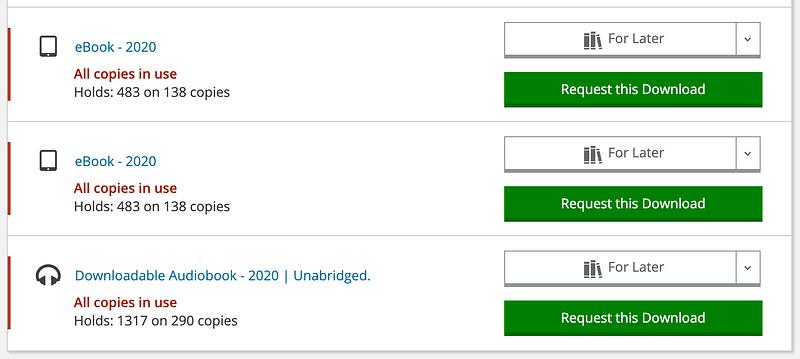
Obama is a hell of a man, and I’m sure A Promised Land is a hell of a book. But for these 1,400 people, is reading A Promised Land going to substantially improve their life in any way? Probably not. Heck, I’d be surprised if more than 400 of those 1,400 people actually got around to reading it at all. A Promised Land is on their reading list because it’s a “good book,” not because it’s the right book.
There are a lot of good books in the world, but there are literally millions and millions of books, and you only have one lifespan to spend reading. Don’t use that time to read any old book; use that time to read the right book.
In Conclusion
The more books you read, the more come to realize you simply don’t have enough years in your lifespan to read all the good books that exist in the world. You can spend a lifetime reading good books only to die feeling like you only got to read a fraction of the world’s great works. To make the most of your limited time, you’re going to have to prioritize.
Discriminate aggressively. Select only best-in-class books, books that are respected and considered “worth reading” among experts and well-qualified people. To spend your time reading anything else is a waste.
Want Great Book Recommendations?
If you want more great books, check out my ebook 5 Breakthrough Books That Will Change the Way You Think. It’s about five of my favorite books and how they might change your life.
Get 5 Breakthrough Books That Will Change the Way You Think here!
Enjoy this kind of writing?
I send one email a week about AI, intentional living, and doing meaningful work in a world that won't stop changing. Join 700 other subscribers.
Keep Reading
Your Clothes Use More Water Than Your AI
The environmental case against AI doesn't survive contact with the data
Apps Will Soon be Replaced by AI
The first new computing interface in sixty years doesn't need them.
AI Is Building the Biggest Porn Machine in History
The industry that monetizes child rape videos just got mechanized production