Stephen Pinker’s Enlightenment Now Unexpectedly Transformed My Life
This article contains an affiliate link.
If there’s anything all media outlets have in common anymore, it’s their desire to convince you we are living in uniquely terrible times. Social media, CNN, MSNBC, Fox News, and even Vox and Quartz and Breitbart and The Daily Wire are all more alike than they are different because all of them only get paid if they convince you the world is fucked. They all have different theories for why the world is fucked, of course, ranging from populists to ethnic minorities, but they do all agree the world is fucked.
This attitude carries over so far into mainstream life that it’s difficult to find someone who doesn’t think the world is fucked in at least one way or another. My social group comprises people with a wide array of beliefs, and I regularly experience days where I begin the day listening to someone explain why politically correct progressives are ruining everything and end the day listening to someone explain why bourgeoisie capitalists are ruining everything. But everyone, everywhere, is convinced that someone is ruining something.
Except for Stephen Pinker.
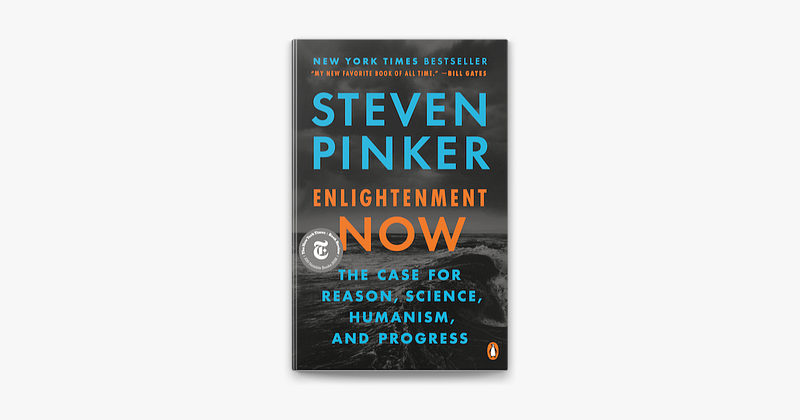
Enlightenment Now: The Case for Reason, Science, Humanism, and Progress by cognitive scientist and neurolinguist Stephen Pinker is an excellent book for so many reasons, but it is, first and foremost, a book about why everything isn’t fucked. Far from it, actually — we’re living in the most prosperous and peaceful times that have ever existed in all of human history. Things are literally better than they’ve ever been.
Not convinced? Consider these arguments, pulled from Enlightenment Now:
Global life expectancy has risen dramatically
Global life expectancy has risen from 32 years to 71 years, over double what it used to be. Much of this growth is thanks to reduced infant mortality, as infant and child mortality significantly dragged down those averages.
Poverty has fallen drastically
For most of human history, nearly 90% of people lived in extreme poverty, which is to say, they were at risk of starving to death or dying of exposure nearly every winter. Slaves would fight over bones to suck the marrow out of them, and cannibalism was not unheard of. To be human was to live near the brink. Today, the proportion of people living in extreme poverty has dropped from 90% to 10%. Compared to our ancestors, even the poorest among us live like land barons.
There is almost no war
We think of war as an enormous and unusual human tragedy. But for most of human history, war was the norm, and peace was nothing more than a brief interlude to rest and recuperate before the next war. The era of peace that set in following World War II has been so peaceful for so long that historians actually have a name for it: The Long Peace. Even the wars we do have today are relatively bloodless. Upward of 200,000 people have died in the Syrian conflict, it’s true, but that death toll is nothing compared to the Korean War (300,000), Vietnam War (1,300,000), World War I (40 million), World War II (85 million), or any of the formal and highly militarized wars that preceded modern warfare, for which a death toll of 200,000 was table stakes. War in the past was just much, much, much bloodier.
We’ve eradicated many deadly diseases
We’ve come a long way in conquering disease. Antibiotics, antivirals, and supportive fluids and care save millions of lives each year. The coronavirus pandemic drives this point home — while it’s tragic that 2.7 million people have died so far, the Spanish flu of 1918 (which everyone compared coronavirus to early on) killed 50 million people. Hell, smallpox killed two million people a year, and people thought that was fucking normal until scientists eradicated it. And for every coronavirus, ten coronavirus-like pandemics are halted in their tracks by epidemiologists (SARS, MERS).
Human rights are becoming widespread
Human rights are catching on like wildfire too. It may feel like we’re living in a uniquely racist, sexist, and homophobic era, but the reality is that this is simply the first time in human history we’ve been allowed to complain about it and agitate for change at such a large scale. Consider racism; police brutality is bad, but police brutality was worse in the fifties. During the Jim Crow era, it wasn’t called police brutality at all, but merely good police work. Or consider homophobia; this is one of the first times in human history that large coalitions of nations have removed homophobic laws from their books, let alone permitted same-sex couples' legal marriage. Human rights obviously have a long way to go, but they’ve come a long way, too.
The real kicker? All these changes happened over the past 300 years. The story of the human race was of thousands of years of ceaseless starvation, war, poverty, and death… until now.
The bulk of Enlightenment Now is about these positive changes. Pinker exhaustively combs over the data and provides the reader easy-to-understand charts about how good things are lately and how they got that way. You won’t believe how many good things actually are happening right now.
He does this all with approachable language — this book is so thick you could use it as a brick for building houses, but reading it took no time at all thanks to Pinker’s easy and entertaining style.
He also explains why the bad things happening now aren’t the end of the world. It felt scary for Trump to be President, and it is weird how populism is having a resurgence in several locations in the west, he explains, but their growth is predicated on demographic trends that we can’t expect to continue. Simply put, the data shows it’s mostly older adults supporting these movements, and older adults eventually die. We have every reason to believe that, with diligent work, we will continue to see the western world continue its upward trend, albeit with normal bumps in the road.
The best part is, all his claims are well-defended. He cites studies, displays his data, explains why he displays his data the way he does — and explains why he chooses to leave certain things out, too. Nothing is spin-doctored or dressed up to mean more than what it is. When the data contains interesting irregularities, he doesn’t smooth it out of the charts but stops and respectfully explains to the reader what the irregularity is and why it’s there. Nothing about this book feels like a huckster selling a point of view. He also at no point appeals to an ideology of any kind, whether religious, political, economic, or otherwise. Pinker is, first and foremost, a man of data.
Enlightenment Now is so well-reasoned and so well-defended, in fact, that I’m embarrassed to have ever had opinions or thoughts about political or cultural affairs before reading it. So many foolish positions I’ve heard either myself and others take blow away like so many autumn leaves in the wind of Pinker’s data.
Pinker ends by explaining these positive results are not the result of some passive happenstance but the result of specific Enlightenment-era principles of reason, science, and humanism. If we want to continue our progress as a species, we need to hold fast to these values.
None of this glowing praise is to say we should stop feeling concerned about racism or extreme poverty. We are capable of appreciating modern problems as they are without sensationalizing them as The Worst Problem Ever.
In fact, sensationalizing problems as The Worst Ever probably prevents us from finding solutions. If we can appreciate the progress we’ve made, we can look to successful moments from our past and present to engineer new solutions to the problems that face us. Sensationalizing issues also makes people overemotional, which always affects our ability to think creatively and productively.
For some people, Pinker explains, sensationalizing issues can make people feel burnt out and hopeless, causing a sort of anti-activism. Hopeless people don’t try to solve societal problems they believe can’t be solved. He says that what we ought to do is take a hard look at issues as they are.
Enlightenment Now was an excellent book for me because it reminded me to hold fast to reason and common sense in an era where everyone with access to an audience takes up a cause and fans the flames of frothing rage.
As a content creator myself, I have before felt pressure to take up a cause. Every time some scandal hits the news, part of me thinks I should be “making the world a better place” by “educating my readers,” that is to say, frothing at the mouth and ranting and raving about the scandal of the day. It seems like there isn’t a day that goes by without someone reminding me that I am a callous and uncaring human being doomed to hell for my lack of empathy because I don’t have social media and don’t froth at the mouth for my readers. It’s reassuring to read a book by someone that agrees that maybe all this mouth-frothing isn’t fixing anything and isn’t really necessary in the first place.
If you’re sick and tired of consuming half-baked news stories and YouTube videos by pundits and walking away still feeling like you’re getting nothing but bias and superficiality, read Enlightenment Now. It’s a rare oasis of levelheadedness and reason in an environment that’s otherwise turned into an echo chamber.
Want to Read More?
If you want more thought-provoking articles like this one, my newsletter Seeking Truth was made for you.
Enjoy this kind of writing?
I send one email a week about AI, intentional living, and doing meaningful work in a world that won't stop changing. Join 700 other subscribers.
Keep Reading
Your Clothes Use More Water Than Your AI
The environmental case against AI doesn't survive contact with the data
Apps Will Soon be Replaced by AI
The first new computing interface in sixty years doesn't need them.
AI Is Building the Biggest Porn Machine in History
The industry that monetizes child rape videos just got mechanized production