Tidy Up Your Career with Marie Kondo’s Book, ‘Joy At Work’
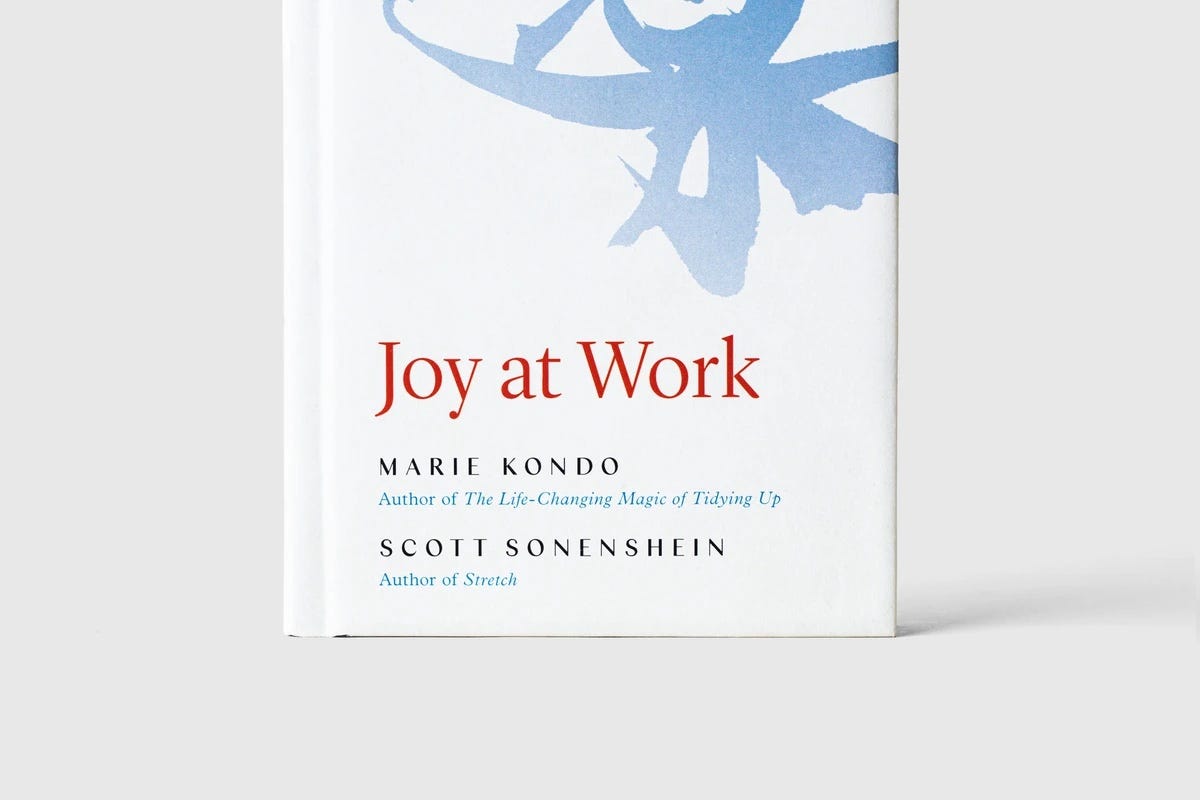
Marie Kondo has done it again. After writing The Life-Changing Magic of Tidying Up and following it with the wonderful Spark Joy, Marie Kondo has written a new book called Joy At Work: Organizing Your Professional Life⁰.
Joy At Work is about what any Marie Kondo book is about — tidying up your surroundings so you can lead a life that sparks joy. This particular book focuses on tidying up your work life, showing you how you can bring joy to your desk, emails, meetings, and every other part of your working day.
Unlike her other books, Joy At Work is written in partnership with another author — organizational psychologist Scott Sonenshein. Sonenshein, who has been called “The Marie Kondo of work,” is a Professor of Business at Rice University and the author of Stretch: Unlock the Power of Less — and Achieve More than You Ever Imagined.⁰ In Joy At Work, Sonenshein helps you use the magic of the KonMari method to tidy up nonphysical work-life clutter like excess meetings, todos, calendar events, work teams, and more.
The book Sonenshein and Kondo have written together blends the best of their worlds. Joy At Work is still recognizably a Kondo book, written in her trademark joyful style, and Sonenshein’s writing brings science-backed research and field-tested wisdom to her work. Together, they create a business book unlike any other.
The Joy At Work Model
Those familiar with Kondo’s previous books are familiar with her household-based model for tidying up, the KonMari method. The steps of the KonMari method are:
- Gather everything of one category together in one place, one category at a time. First clothes, then books, then paper, then komono, and sentimental items last.
- Go through the categories one at a time, holding each item and asking yourself if it sparks joy.
- Thankfully donate what does not spark joy, and mindfully store what does — storing your possessions upright or in such a way that they are all visible and nothing gets buried.
I swear by the KonMari method, but some people think it has its’ problems. For instance, most people have meetings, emails, and papers necessary for work and life that they must keep regardless of whether they spark joy. Most people also do not have the same level of control over their work environment that they do over their home.
In Joy At Work, Sonenshein and Kondo have together come up with a version of the KonMari method that addresses these objections.
- Gather everything of one category together. First your desk items, then your digital files, then tasks and calendar items, so on and so forth.
- Ask yourself these three questions: Is it necessary for my job? Will it contribute to future joy at work? Does it spark joy today?
- If the answer to all these questions is no, discard the item with gratitude. If the answer is yes to any of them, mindfully store them (if applicable).
Two things are interesting about this model.
The first is that it deals with intangibles, like decisions, meetings, calendar events, and work teams. The home-based KonMari method does not deal with intangibles because there is nothing intangible about cleaning your home. With the rise of digital work, however, there are loads of intangibles involved in your work life, and those intangibles need tidying up too.
The second is that instead of merely asking whether these items spark joy, you acknowledge the reality of work by asking yourself not only whether something sparks joy now but also if it will in the future and if it’s necessary.
“Is it necessary for my job?”
We all have some work responsibilities which are just necessary. Medical office workers need fax machines. Accountants need records of their clients’ tax forms for the past 7 years. Service industry workers need cushioned shoes for long hours spent standing. These things must stay, regardless of their joy-sparking potential.
“Will it contribute to future joy?”
We do many things at work that don’t spark joy right now but contribute to future prosperity, like studying for certifications or volunteering for additional projects at work. They are not necessary for us to carry out our day-to-day duties, but they help us create a more joyful future. They don’t spark joy now, but doing them will lead to a future full of joy.
“Does it spark joy now?”
The last and most joyful category — things that spark joy. If something about your work life sparks joy, joyfully keep it. As we mature in our work life, we are hopefully doing more of what sparks joy and less of anything else.
Show gratitude for what remains
If you’re like most people yoked under late-stage capitalism, there are likely many things left over that don’t spark joy. You can lessen the burden by show gratitude for what remains.
Kondo specifically recommends gratitude for necessary items you must keep. Doing so increases the amount of joy they bring you. For instance, keeping tax records for the trailing seven years doesn’t sound joyful at first, but keeping these tax records protects you from fees and fines from the IRS. It brings me joy whenever I’m protected from fees and fines! Once you truly appreciate how these necessary items contribute to your life, Kondo says, they will spark joy for you.
- Thank those ugly black shoes for bringing your feet comfort every day while you’re at work.
- Thank your seven years of tax files for being there if you are ever audited by the IRS or an irate client.
- Thank your fax machine for getting your office vital documents without violating HIPAA law, protecting both your company and your patient’s privacy.
In the same way, items that will spark future joy are also deserving of your gratitude. They may not bring you joy now, but they are directly enabling you to create a future that will be filled with it.
It’s unlikely that showing gratitude for stuff about work that doesn’t spark joy will transform a miserable job into a joyful one overnight. But gratitude has scientifically proven benefits, and you can take advantage of them by using gratitude to make your life a little better.
What and How to KonMari at Work
In Joy At Work, Sonenshein and Kondo recommend you tidy these things in this order:
- Your Workspace (books, papers, komono, sentimental items)
- Digital Work (digital files, email, apps)
- Time (tasks, calendar)
- Decisions
- Network (contacts, LinkedIn, e.t.c.)
- Meetings
- Teams
Like the home-based KonMari method, each category needs to be done on its own, by piling everything of one kind together for tidying. Unlike at home, though, Kondo says you do not need to do these categories in order. The important part is that you take the categories one by one, everything at once.
Since work assets are slightly different from items in your home, Sonenshein and Kondo have a slightly different methodology for tidying each category. For instance, for your workspace, you can use the traditional KonMari method, except instead of asking merely whether your items spark joy, you ask whether they fall into one of the three categories. And for tidying your network, you go to wherever you have contacts, whether that’s in your contacts book, your CRM, LinkedIn, or elsewhere, and apply the three questions. The methodology used varies on what kind of thing you’re tidying.
After all the chapters on these tidying categories, Kondo and Sonenshein discuss how to self-reflect on joy at work, how to pick a job that sparks joy for you, and how to carry the tidying process into the rest of your career. The authors share intimate stories from their own work lives and show you how you can spark joy in your own work life.
Joy At Work Transformed My Career
No joke, reading this book changed the way I work. I’ve been a physical minimalist for years, but the nonphysical nature of digital assets enabled me to turn into a file hoarder. For a while, I scanned anything and everything, regardless of whether it added any actual value to my life, and filed every scrap of digital information. No joke, I had scanned Kroger receipts from six years ago on my computer until I read this book.
This seemingly harmless habit had real costs.
- Any time I wanted to access a digital file, I had to search through a glut of records to find anything. This added several minutes (or, occasionally, hours) to the searching process.
- It cost me all the time it took to scan all of these records in the first place. I’ve probably spent nearly a hundred hours hunched over a scanner.
- It also cost me cold hard cash because I had to buy computers with bigger and bigger hard drives to store all this junk, external hard drives to store the overflow junk, and extended cloud backup packages to protect it all.
In these last few years, I’ve curbed this tendency somewhat. I’ve learned I don’t need to scan every medical bill from every collections agency that comes across my desk. But I still frequently find myself with a loose pile of digital documents, saying to myself, “I really need to go through that.”
The way I managed my to-do list was even more frightening.
Prior to reading Joy At Work, I routinely had 15–20 categories on my digital to-do list at any given time, each with up to 150 tasks in it. Yes, you read that right — there were times I had as many as 1,500 tasks on my to-do list.
I’ve made multiple attempts to curb this habit, doing big “to-do cleanups” the same way some people sit down and spend six hours getting to inbox zero. While each attempt helped me out a little, they never fixed the problem. Like the suburban Americans Kondo rescued from clutter years ago, I was desperately in need of something more.
I’m thankful to Kondo and Sonenshein for writing Joy At Work because this book is what I needed.
Now, instead of uncountable categories of tasks, I only have 4. They are all sorted into Core Tasks, Project Tasks, and Developmental Tasks, for a total of 12 subcategories. I haven’t even officially tidied my tasks yet, but already there are only a fraction of the tasks there used to be.
The best part is, I haven’t experienced any relapse. Applying Kondo and Sonenshein’s three questions to all of my digital clutter has enabled me to keep the digital clutter from overwhelming me again.
If you’re drowning under a sea of tasks, emails, responsibilities, or even just don’t always feel on top of things, read Joy At Work and learn a new way of managing your career — one that will spark joy in the process.
Want to 10x Your Productivity?
If you want to stop wasting time and finally start getting stuff done, my free course 10x Your Productivity is what you need.
Sign up for 10x Your Productivity now!
0: This is an affiliate link.
Enjoy this kind of writing?
I send one email a week about AI, intentional living, and doing meaningful work in a world that won't stop changing. Join 700 other subscribers.
Keep Reading
Your Clothes Use More Water Than Your AI
The environmental case against AI doesn't survive contact with the data
Apps Will Soon be Replaced by AI
The first new computing interface in sixty years doesn't need them.
AI Is Building the Biggest Porn Machine in History
The industry that monetizes child rape videos just got mechanized production