Why I Gave Up Music For 30 Days
Why I Decided To Give Up Music
Before this experiment, I listened to music a lot. Like, a lot. I listened to music whenever I was home. Or in the shower. Or hanging out with friends. Or in the car. Or walking anywhere. In fact, the only times I didn’t listen to music was when I was out in public businesses with friends or specifically making time for mindfulness.
But one day, while rereading Coach Tony’s iPhone optimization guide “How to Configure Your iPhone to Work for You, Not Against You” (which I highly recommend), I came across the following passage:
A lot of people have trained themselves to listen to music while they work. But almost all research says that performance is poorer in the presence of a background sound.
If this were written by some random person on the internet, I wouldn’t believe them because it lacks citation. But Coach Tony is the CEO of Coach.me, and therefore has literally thousands of people’s experiences to draw from. He coaches people for a living. If he’s telling me music doesn’t enhance performance, I’m inclined to believe him.
Over the next few days, I thought about my own life. How often do I really sit down and mindfully enjoy the music I love so much, and how often do I just turn it on compulsively, the riffs of my rock music becoming merely part of the background noise of my apartment?
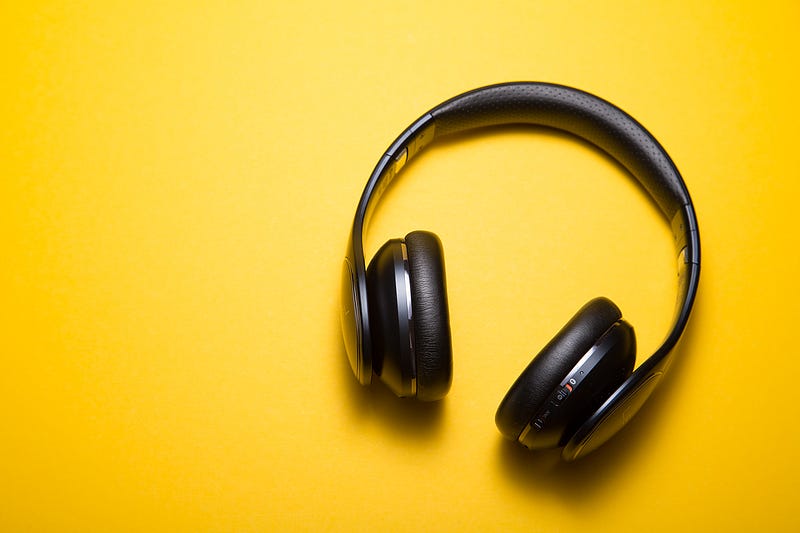
I’m not a big believer in background stimulation — my phone is configured so it barely ever notifies me, my apartment is arranged so the only television is hidden in an entertainment room (where it is usually turned off), and I own one of the best noise-canceling headphone sets on the market. So if my compulsive music habit is merely background stimulation that is more distracting to my brain than it is relaxing, I don’t want it around anymore.
So maybe the science says music is bad for performance. Maybe that science is bunk. But I don’t need the science to know — I can test it out for myself. If I give up music for thirty days, I’ll know — either my life will get better, or it will get worse.
So as of January 5th, 2019, I began my thirty days with no music.
What I Did Instead
There are two major things I used to replace music: Podcasts & Audiobooks, and Brain.fm.
Podcasts & Audiobooks
One of my biggest analytical weaknesses is that I’m not able to follow verbal arguments very well. If you start explaining a complex economic issue to me instead of allowing me to read about it, I’m going to lose the thread of what you’re saying faster than an ADHD child can spot a squirrel. While most people seem to be able to listen to audiobooks at 1.25x speed, I need things slowed down to 1x or 0.75x in order to follow who’s speaking.
As a result, listening to content isn’t very rewarding for me. I can read an entire book in one day, whereas it takes me three hours just to get through one chapter of an audiobook. I’ve never bothered to listen to podcasts or audiobooks, because why would I?
This is more than just a content preference. It’s gotten in the way of my life:
- When people want to show me a podcast or YouTube video, I have to either forcefully decline, or sit through something I don’t understand while I pretend I do.
- I’m not able to have long phone calls with friends, business contacts, or pretty much anyone.
- I’m not able to have long, complex discussions with friends about world affairs.
- Depending on the day, I’m not able to have any kind of long conversations at all.
My workaround has simply been a policy of not listening to audiobooks or podcasts except in times of dire need (example of dire need: I’m trapped alone in a car for more than eight hours).
The No-Music Challenge is my golden opportunity to change that. Over the next month, I can listen to podcasts and audiobooks regularly and see if continual practice helps sharpen my verbal reasoning skills. My goal over the next thirty days is to level up my listening speed to 1.15x. If I can make listening to audiobooks a little faster, it won’t be such a waste of my time.
This will also make it possible for me to listen to podcasts. I feel I’m able to get a more than satisfying education without podcasts, but podcasts are more than a way of educating yourself. For many educated people, podcasts are a cultural touchpoint. People in the same field will all listen to the same podcast. People discuss together what various podcasters have to say. If I’m able to listen to podcasts, I’m able to participate in these discussions.
If I’m able to listen to audiobooks at a reasonable speed and listen to podcasts, a whole new avenue of learning opens up to me.
- I can start listening in the shower, or when I’m driving
- I can listen to podcasts with friends and loved ones, pausing along the way to have rewarding conversations
- Part of the reason I don’t cook is that I find it boring; if I’m listening to a podcast while cooking, though, that boring time could be transformed
Brain.fm
In the same section that Coach Tony points out that music is bad for your performance, he says:
There is another approach: an emerging field of auditory science used to boost focus and reduce mind-wandering.
Brain.fm is the best of these brain music options.
Brain.fm is an app that generates background music for you depending on your goals. They have three “moods” (focus, relax, and sleep). Just pick your mood, and Brain.fm will generate some pleasing background music for that mood.
The selling point of Brain.fm is their clinical studies which demonstrate that Brain.fm is more effective than both music and silence for helping someone achieve sustained performance.
While, as Coach Tony points out, this is a study funded by a company and therefore biased, my experience is that Brain.fm does work. In addition to using Brain.fm for these 30 days, I used to use it regularly about two years ago, and both times it helped me relax and get in the zone.
Plus, when I use Brain.fm, I get to make use of my wonderful noise-canceling headphones.
The Results
Days 1–7
The first two days were rough. I deleted my music app off my phone so I couldn’t compulsively open it, but nevertheless, The Twitch kept driving me to open my phone and look at the spot where it used to be. That spot is now occupied by Brain.fm and the Podcasts app, irrationally angering me.
The other behavior I noticed was that I started singing all the time. No matter what I was doing, I would just start singing. I would sing anything from The Beatles to Adele to Five Finger Death Punch. It felt as if my brain was fighting back; if it couldn’t listen to music from my phone, it would listen to music from my mouth.
On day 6, I had a dream where I was listening to music. I woke up with the song stuck in my head.
Since it’s so early, it’s hard for me to tell, but it feels like I’m calmer.
Days 8–15
Driving somewhere in the car without music still feels weird.
I’m still hearing music in my head at random times, but now the songs are weirder. Songs I haven’t listen to in years are bouncing around in my head. I hope this will stop soon; I want to experience real silence.
I am, however, definitely calmer. I’m able to sit in a quiet room without feeling like the situation is missing something. I’m able to just be.
Days 15–30
I was starting to get sick of not having music. During car trips to the grocery store, or times when I was doing low-involvement tasks like tidying my room or washing dishes, I missed the opportunity to enjoy my music.
On January 28, I caved. After four hours of a six-hour drive, after listening to my partner sing Take Me Home, Country Roads in my ear several times, I turned on John Denver. His voice was possibly the most magical thing I’ve ever heard.
Once the dam broke, I was back to listening to music for an hour or two each day. Instead of going the full 30 days without music, I only went 23.
Conclusion
When I started this experiment, I really didn’t expect much. I thought that since I don’t have social media, I don’t check email on my phone, and I don’t watch TV, there wasn’t anything about my digital devices to which I was addicted.
Boy, was I wrong. The Twitch, which I thought was gone forever, returned in full force when I deprived myself of a constant stream of music. It makes me wonder what other behavioral addictions are still there, lurking beneath the surface. Now that I’ve started listening to music again, I’m experiencing the temptation to turn it on during every single spare moment.
But, I’m resisting that temptation. Music is nice during car rides and when doing the dishes, but the compulsive 24/7 way I was listening to music was definitely interfering with my peace of mind.
And, it was interfering with my productivity. After switching to Brain.fm, I noticed that my working sessions were massively more productive. Despite feeling blocked and undermotivated, I was able to write hundreds or thousands of words in under an hour. Something about Brain.fm’s artificial music really does work.
As for the podcasts, though… that didn’t pan out. Listening to them was so frustrating for me that I never really got started. Outside of listening to podcasts while running, I’m just not interested. I’m going to have to come up with a way to make podcasts and audiobooks more appealing for me going forward.
So do I think you should give up music? Not necessarily. Music brings a lot of meaning into many people’s lives, mine included. But I do think you should give up putting on music as a form of background noise; if you are going to listen to music, do so mindfully. Sit down with the intention to enjoy music, instead of using it to create a monotone background noise. You’ll enjoy it a lot more that way if you do.
Want to start being seriously productive? Sign up for my free Get Productive email course.
Or, if you just want more stories like this, sign up for my weekly digest.
Enjoy this kind of writing?
I send one email a week about AI, intentional living, and doing meaningful work in a world that won't stop changing. Join 700 other subscribers.
Keep Reading
Your Clothes Use More Water Than Your AI
The environmental case against AI doesn't survive contact with the data
Apps Will Soon be Replaced by AI
The first new computing interface in sixty years doesn't need them.
AI Is Building the Biggest Porn Machine in History
The industry that monetizes child rape videos just got mechanized production